Retirement comes easier for some than others. Despite years of reading and preparation for retirement, it was hard for me to accept that I could simply sit around doing whatever I wanted to do without contributing in some way to the good of humanity.
“Fransen family guilt syndrome” (you can look this up in the Diagnostic and Statistical Manual of Mental Disorders, DSM-5 – it’s just below “I can’t believe you are really looking this up”) kept calling out to me: “by what right are you occupying this piece of earth?” and “how are you contributing today to the good of society?” and “what have you done today to deserve the breath you just took?” Not to mention the lack of positive reinforcement that comes from a daily flow of satisfied clients. All of a sudden, on January 1, 2016, that flow stopped when I retired and nothing had taken its place.
Initially retirement was great. We took delivery of our motorhome, and immediately headed out for a road trip. By April of 2016, however, while lazily enjoying the spectacular view from our RV site in Southern California, I found myself googling information about taking the Bar exam in our newly adopted home state of Oregon. The deadline was the next day.
So, almost two years ago to this day, I feverishly put together and timely mailed my application package to take the Oregon Bar, and sent in my $3,000 to take the Bar/Bri bar review course.
Three days later I broke my hand.
The Oregon Bar people were nice, and gave me some of my application fee back. Bar/Bri however exerted a vice-like grip on the funds I paid them. NO refunds. Period. OK, how about I donate my Bar review course to a needy law graduate who would otherwise be unable to pay for it? NO. Period. May I defer and take it another time? Yes, until Kingdom comes. So I deferred every 6 months until last Fall. By then, I had gotten tired of dealing with Bar/Bri, and it irked me that I could not get any benefit from the bar review course I had bought unless I used it myself. And, I needed something to do during the dreariest winter months in Portland. With no plans to go back into law practice, and really for no good reason at all, I re-applied to take the Oregon Bar exam to be given at the end of February 2018, and started the bar review course on January 1. I figured that it was my personal Alzheimer’s test. If I can pass the Bar exam, then maybe I don’t have Alzheimer’s. Yet.
I quickly realized that there was way more material to learn than can be mastered, even though the course was basically all day, every day, 7 days a week for two months. During those two months I asked myself over and over again, why am I doing this? Avid reader and cousin Dave, in whom I had confided, cannily observed that enduring the Bar exam with no clear purpose to use your law license was the definition of insanity. I had no defense.
It was tempting to bail. Almost no one would know. But every time I got close to withdrawing, I started a new practice exam and once started could not stop. Every fact situation was a new problem to be solved. It was addictive.
Many people have asked “how was it?”
You would think it would be a lark, since I had passed the California Bar in 1977 on my first attempt, and had practiced law for almost four decades. You would also think it would be low stress, since I really did not have plans to go back into practice. To the contrary, my heart was pounding out of my chest cavity the first morning of the exam. I’m still not sure why. Maybe the potential embarrassment at failing now is worse than the potential inability to provide for my family was 40 years ago.
And for a number of reasons it was actually harder than the first time:
- In 1977, I had just finished three intense years of law school study covering all the Bar topics; now that working knowledge is 40 years old (meaning, gone forever).
- In 1977 I had a 25 year old brain; now I have a 65 year old brain which does not retain nearly as well.
- Decades of hard won wisdom and experience turns out to be worse than worthless. Here is the analogy: the Navy and Air Force prefer non-pilots for pilot training. Private pilots have to un-learn civilian techniques before they can learn the military way. Same here: everything I knew about California law I had to un-learn, so I could learn the common law, the majority view, the minority view, and the model code. Everything except the actual law of California or Oregon!
In many ways the Bar exam tests the wrong things, and fails to test actual competency to practice law. It would be like medical students having to learn the proper placement of leeches, rather than modern diagnostic and treatment protocols. Maybe the point is not to determine what you actually know, but rather your ability to learn a vast amount of material, in a very short period of time, in a high-stress environment, and regurgitate it in a prescribed way. If you get through this, you may not be ready to practice law, but you are ready to learn how. Like a private pilot license, maybe it is just a license to learn.
As the day approached when the results were to be announced, I found myself ambivalent. If I failed, that was that, I can close the Bar/Bri file forever, and no need to think about it ever again. If I pass, though, decisions need to be made. Should I take the oath and pay the Bar dues and insurance premiums? Then I’ll need to look for something to do with my ticket just to cover expenses. Or should I just take the oath and immediately go to inactive status, which makes all of this an utter waste of time and money. Yes, it would be much simpler to flunk and remain on the retirement trajectory to which I am slowly becoming accustomed.
The letter from the Oregon State Bar arrived at home this week while we are still on our latest road trip. Daughter Kate had been checking our mail and called me. I stepped out of a busy restaurant to take the call. “Well.” I said, “what’s the word?”





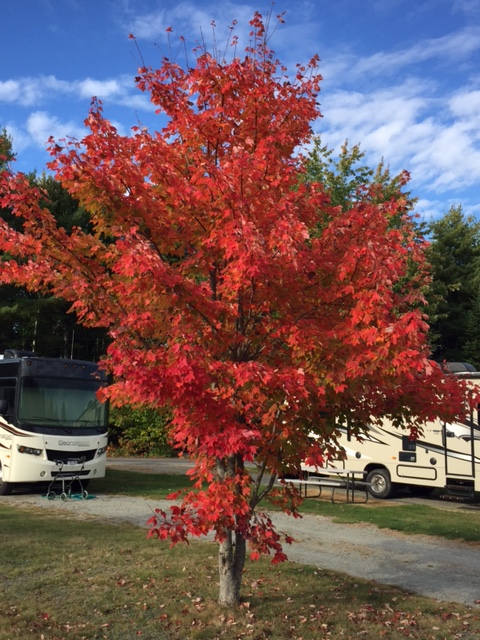
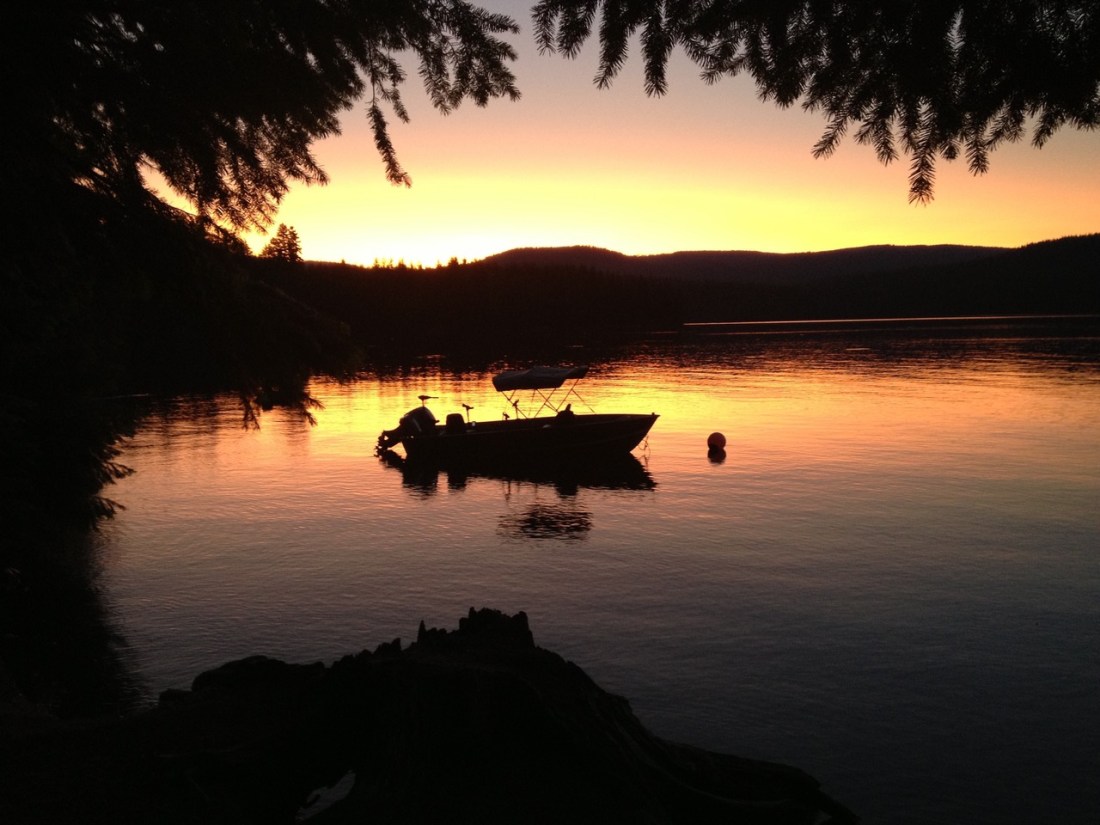 somewhere fun and interesting and completely different to camp that is an easy weekend drive. For example, from the heart of California you have the following choices for an easy (1 hour to max 4 hour) drive: LA, Lake Tahoe, San Francisco, Yosemite, the Napa Valley, Sequoia National Park, the central coast, Santa Cruz, Santa Barbara, Monterey, Big Sur, and if you stretch it another hour or so, you can add Mammoth Lakes, San Diego, Death Valley, and Las Vegas. In mid-America you can travel hundreds of miles and it is pretty much all the same. If you leave your home in the corn and soybean country of Iowa and travel 3 or 4 hours, you are still in corn and soybean country. If camping is your thing, and you live in mid-America, you might as well go to the KOA that’s 20 minutes away rather than the one that’s 4 hours away, and spend more of your time in the campground rather than on the road. It’s all going to look the same anyway. The result is that even as Fall
 and enjoying the hokey things all the campgrounds do to get and keep you there, like hay rides, crafts, bicycling around the campground, breaking limbs on play structures, kayaking on the pond they dug out. Decorating for Halloween is an art
 form there too. Hey it’s either go camping or head to the casino. So camping in mid-America is generally not the experience of exploring some place different and adventurous. It is the experience of just hanging out at the campground.

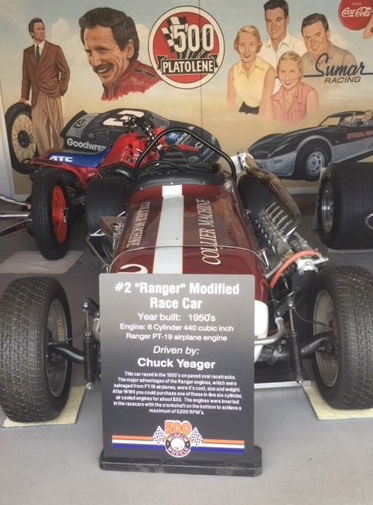 track, and there are car museums everywhere. We missed the DeKalb turnoff, which thereby wiped out the possibility of seeing no less than 47 auto-related museums. The 500 Museum of Wheels (500 what? we don’t know) in Terra Haute had an open wheel racecar with an airplane engine that had been driven by Chuck Yeager (the first person to go BOOOOM! in an airplane that did not blow up.) Notable quote the day he broke the sound barrier: “Hey Ridley, I got me a little problem. I fell off my horse last night and busted up some ribs; I can’t tell these guys because they won’t let me fly today.” “OK Chuck, let me see what I can rig up.”





 Canada’s flag, by the way, is considered one of the world’s best by world-renowned Vexillologist Ted Kaye, who literally wrote the book on what makes a good flag: “Good Flag, Bad Flag.”















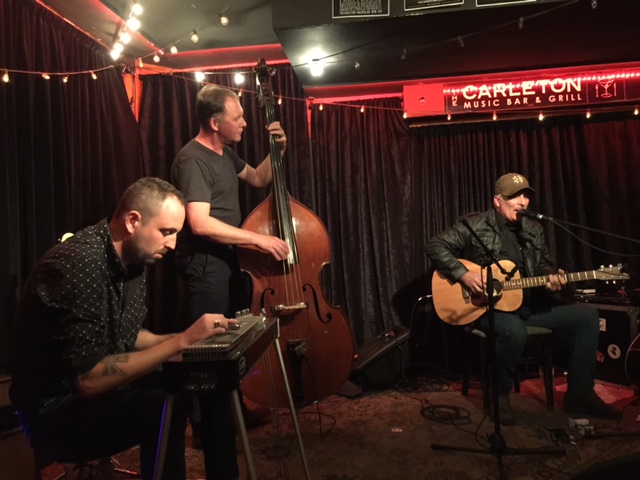
 Carleton, creative cocktails at Lot 6, the longest civil rights protest ever in Africville. I told her she made me feel at home with her wild hair color and tattoos, Portland being a haven for both. She has a young daughter about 8 years old, who shares the same fiery hair color, but no tattoos as yet. Another barista, also named Kate, who did not change
 her name, reminded me in her mannerisms of my non-Kate daughter Jen (real name Jenny), and this Kate also wanted to make sure I knew all about their town. I always seem to find a home base, usually a coffee shop, where I can work on this blog, catch up on emails, read the news (which is inevitably about Trump, Trump, Trump, even in Canada) until I can’t take it anymore, and if I am lucky I will meet someone helpful like the two Kates. No, if my first interaction with the people of Halifax was with Wanda Kate and Kate, I’d have loved the town from the outset.
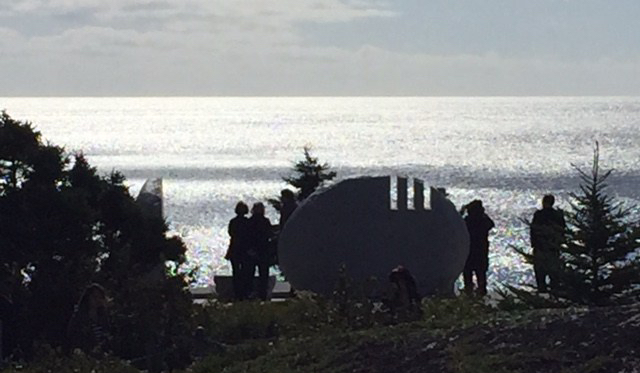
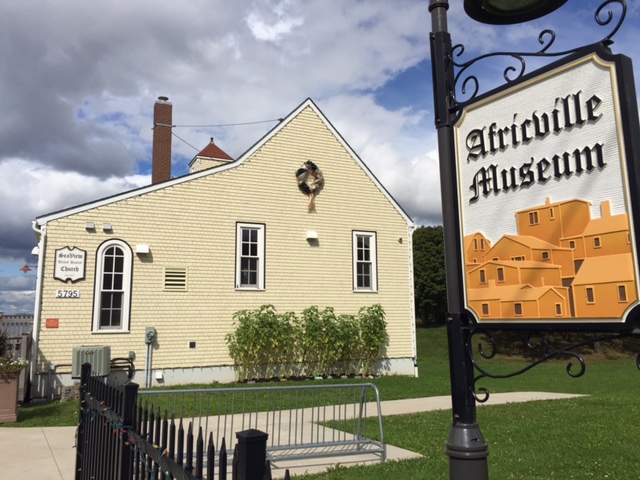
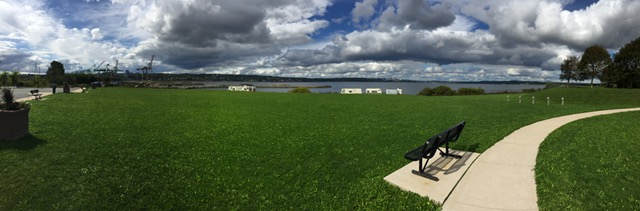 In the distance just beyond the park you can barely see four trailers, and Eddie’s is the one on the right with the tattered sign “Africville Protest.” In 2005, the city of Halifax formally apologized and built a museum:
 I do not know what that means, but stayed clear anyway. In addition to an array of museums and art galleries (including the Canadian Immigration Museum, a concept that would somehow seem more appropriate in the States right now), I saw a poster for the most unusual poetry reading I have ever come across: